

What Skills Mapping Is
The term ‘skills mapping’ refers to a method for classifying and managing workforce skills at a specific point in time, with the goal of understanding employees’ strengths and weaknesses and improving a company’s organizational structure.
Today more than ever, it is essential for companies—especially those that consider data their most valuable asset—to have a tool that allows them to clearly, quickly, and systematically visualize employees’ skills, proficiency levels, and the abilities required to complete specific tasks.
Types of Skills Mapping
There are several approaches to skills mapping, each with specific purposes. It is important to choose the method that best fits the company’s needs to achieve effective results. The main types of skills mapping are outlined below.
Technical Skills Map
This type focuses on the practical and technical skills required to perform specific tasks. For example, in a manufacturing company, a technical skills map may include the ability to operate machinery, knowledge of production processes, and proficiency in equipment maintenance. It is an essential tool for identifying gaps and planning targeted training programs.
Soft Skills Map
Soft skills refer to abilities such as communication, leadership, problem-solving, and time management. These skills are often applicable across multiple contexts and departments. Mapping soft skills allows organizations to identify employees with adaptability and growth potential, facilitating internal mobility and the creation of more balanced teams.
Strategic Skills Map
This type of mapping is long-term oriented and focuses on the skills needed to achieve the company’s strategic objectives. It is an approach used to identify talent capable of leading critical projects or driving innovation. It also helps pinpoint areas where additional training is required to support business growth.
What Skills Mapping Is Used For
The skills map is useful both for employees, to gain greater awareness of their skills and proficiency levels, and for employers, to understand where to intervene with targeted training.
Skills mapping offers numerous and diverse benefits. Most importantly, it enables organizations to identify which employees are capable of performing specific tasks or activities based on their skill levels.
Secondly, the skills map provides an overview of the current and required skill levels needed to complete a specific task. This allows organizations to see both the current state of skills and areas for improvement, suggesting training activities where necessary. Additionally, it is an effective method for tracking progress not only at the individual level but also across teams and departments as a whole.
Finally, skills mapping allows organizations to distinguish between employees who can perform a task at a basic level and those who operate at a more advanced level, thereby identifying the most valuable employees for the organization.
The Stages of Skills Mapping
The main steps to create a comprehensive skills map are as follows:
- Defining the skills required to perform a specific task within the company;
- Analyzing and defining a system for evaluating skill levels;
- Identifying areas for improvement;
- Direct comparison with employees;
- Planning training activities.
These steps are crucial in creating a detailed skills map that clearly and concisely illustrates the current state of skills and areas for improvement, allowing organizations to take action by planning activities aimed at helping employees achieve higher skill levels.
An Example of Skills Mapping
Let’s imagine a company that manufactures electronic components. To ensure effective human resource management, it decides to implement a technical skills mapping. After identifying key skills, such as knowledge of design software and the ability to operate specific machinery, the company conducts individual assessments to understand each employee’s skill level. The results show that some workers need training updates on certain tools, while others have advanced skills that could be leveraged to train new hires. This process allows the company to optimize resource allocation and improve operational efficiency.
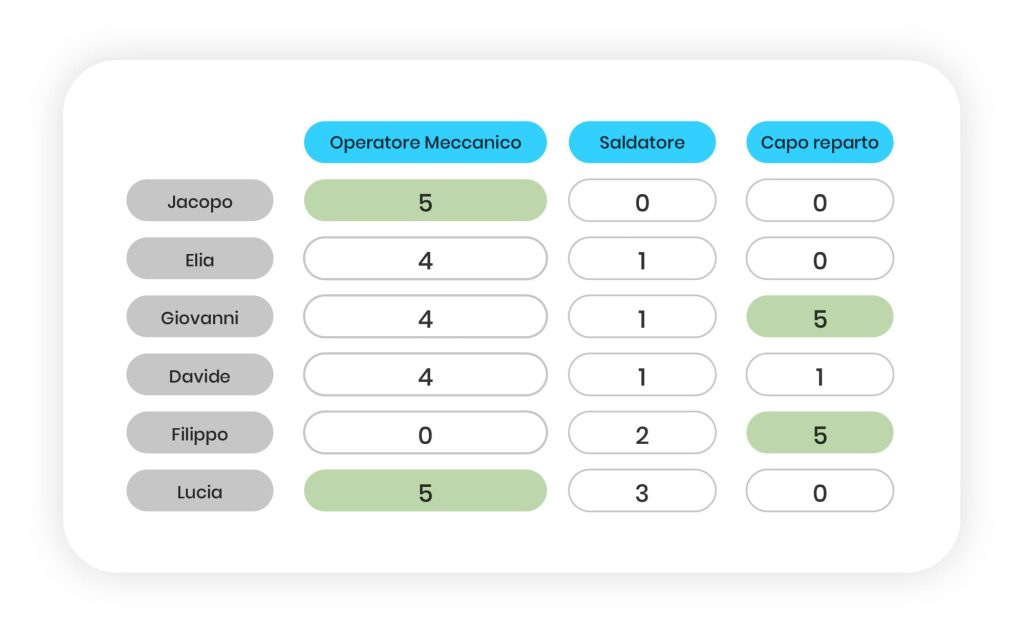
To better understand the concept of skills mapping, it can be helpful to visualize the structure of a typical map: a table featuring a list of employees on the vertical axis, a list of skills on the horizontal axis, and a grid representing the intersection of each person with the skill and the level possessed by the staff.
How to Create an Effective Skills Mapping
Identify Key Skills
The first step for effective skills mapping is to identify the essential skills for each role within the company. This process can be carried out through analyzing job descriptions, consulting with department managers, and directly observing daily activities. The goal is to clearly define which abilities and knowledge are indispensable for success in each position.
Conduct Individual Interviews and Practical Assessments
Once the key skills have been established, it is important to conduct individual interviews and practical assessments to determine each employee’s skill level. Interviews can reveal insights into abilities that may not be evident during regular work activities, while practical assessments provide a realistic view of technical skills. This phase helps identify areas for improvement and potential high performers to be developed.
Continuous Monitoring and Updating
Skills mapping is not a static process. Business needs and required skills can evolve rapidly. For this reason, it is essential to regularly monitor employees’ skills and update the mapping based on new technologies, processes, or strategic objectives. This dynamic approach ensures that the company remains competitive and prepared to face new challenges.
Software for Skills Mapping
As organizations strive to modernize workforce planning decisions, the tools they rely on must also evolve. The digital skills matrix is the ideal tool to continue the process of innovation and improvement within organizations.
There are various software solutions that allow companies to map employees’ skills by cross-referencing data on both soft and hard skills. awm suite is the platform that, thanks to its Skill Matrix section, enables the mapping of employees’ skills within a single, digitalized, and efficient tool.

awm suite’s digital skills matrix introduces:
- Cross-functional skills that update automatically and are accessible to different team leaders;
- A process workflow that allows employees to request approval of their skill, or skill levels, directly from team leaders;
- A training record that contains the list of staff skills and a history that updates each time a skill level changes
This tool automatically records skills, allowing for the planning of the right person with the best skills in the right place at the right time. According to Gartner, assigning the right staff to the appropriate task can increase efficiency by approximately 4%.
awm suite’s dynamic skills matrix automatically updates employees’ skills based on the tasks performed throughout the day, categorizing them according to different proficiency levels.
Furthermore, awm suite digitizes and tracks initial training and machine-specific certifications. The added value lies in the software’s ability to provide an analytics dashboard, offering an immediate overview of skill gaps, based on which suggestions and potential training courses are provided.